UNDERSTANDING COLD CHAIN FOOD WASTE AND WHY IT HAPPENS
Cold chain food waste occurs when perishable goods are spoiled due to inefficient, broken or inadequate temperature-controlled supply chains. Perishable food – like fresh produce, dairy, meat, frozen baked goods, frozen foods, ready-to-eat prepared foods and similar products – are especially sensitive to even short temperature deviations, making them more likely to spoil in such scenarios. Product integrity in cold chain logistics is especially important for these foods.
Cold chain food waste is rarely caused by one failure alone. It can involve temperature failures, delays, condensation, physical damage and mishandling throughout the cold storage and transport process and usually involves a combination of issues. ReFED, a nonprofit that focuses on reducing food waste, finds that nearly a third of cold chain food waste occurs upstream in the process, meaning it happens post-harvest at the storage, transportation, processing and distribution levels, not at the retail or consumer levels.
COMMON COLD CHAIN FAILURES THAT LEAD TO FOOD WASTE
Failures in cold chains most often occur at handover points, where goods are transferred between warehouses, processing plants, and trucks. Breakdowns are especially common during the last mile to the final destination and at smaller distribution hubs, such as sub-centers or village-level facilities. Following is a look at the major failure points that exist:
- Delayed pre-cooling after harvest or production
- Inconsistent temperatures during loading, unloading and cross-docking
- Equipment failures or improper temperature settings within refrigerated transport
- Condensation, ice melt or moisture exposure during cold storage
In addition to temperature issues, another common issue is physical damage to the package itself. This can include stacking failures, box collapse or crushing. These types of incidents, along with temperature shortcomings, can accelerate food spoilage and increase the instances of cold chain food waste. The following secondary packing issues can worsen typical cold chain failures:
- Losing structural integrity when wet
- Restricting airflow needed for temperature stability
- Allowing contamination or product shifting during transit
THE ROLE OF SECONDARY PACKAGING IN REDUCING COLD CHAIN FOOD WASTE
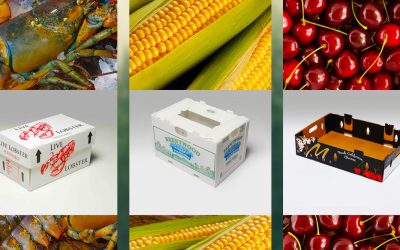
Secondary packaging for cold the chain is a critical protective barrier and needed thermal buffer, helping food withstand cold chain logistics and other fluctuations by shielding products from extreme temperatures, moisture and physical damage. Therefore, packaging durability matters even when proper packaging for refrigerated logistics is in place. While packaging does not cool the product, it does protect product liability when conditions fluctuate. Secondary packaging is key in supporting cold chain performance by providing the following services:
- Maintaining stretch and stackability in cold, wet and even humid environments
- Preventing crushed and bruised product, which accelerates spoilage
- Allowing proper airflow and drainage to reduce condensation-related damage
The difference between fiber-based curated packaging (including those that have been wax-coated) and corrugated plastic in cold chain environments can be the difference between product stability or loss. With fiber, the packaging tends to weaken, collapse and absorb in such environments, while the plastic maintains strength even when wet. In contrast, polypropylene corrugated solutions are durable, recyclable, and maintain their structural integrity throughout cold chain distribution.
HOW COLD CHAIN FOOD WASTE IMPACTS COSTS, SUSTAINABILITY AND FOOD AVAILABILITY
Cold chain food waste is an immensely significant problem. Data from ReFED shows the United States generates 63 million tons of food waste; retail operations experience about $28 billion in lost product value. This financial loss includes direct costs such as spoiled product, disposal fees, rejected loads, emergency re-shipments, and labor associated with repackaging due to temperature-control failures. It also carries indirect consequences, including strained retailer relationships, inconsistent product quality, and reputational risk.
Environmentally, the problem is just as significant, with lost water resources, along with wasted energy, labor and transmission emissions. Methane emissions compound when spoiled food ends up in landfills, and all of these issues can lead to food shortages. Reducing cold chain food waste serves both business and environmental priorities, reinforcing the need for effective cold chain management to improve efficiency and meet sustainability commitments.
PRACTICAL STRATEGIES TO REDUCE COLD CHAIN FOOD WASTE
There are some practical strategies you can embrace to reduce your cold chain food waste and reduce perishable food loss during transport, maintaining cold chain integrity and food quality. They include the following actionable tips.
- Audit temperature control points and identify any instances of recurring breakdowns.
- Improve loading and unloading procedures to limit temperature exposure.
- Use secondary packaging designed for cold, wet and high-handling environments, like polypropylene corrugated plastic packaging and cold seal packaging.
- Reduce repacking by choosing durable containers that maintain integrity.
- Improve coordination between growers, packers, logistics providers and retailers.
Cold chain food failures stem from a range of breakdowns across the supply chain. While upgrading packaging solutions is important, it should be part of a broader system that includes reliable refrigeration, proper handling practices, and optimized route planning.
SeaCa is a trusted packaging partner that can help reduce instances of cold chain food waste by providing reliable secondary packaging for cold chain environments across agriculture, seafood and food service supply chains, including purposefully designed plastic produce packaging, plastic seafood packaging and cold seal secondary packaging.